Snowflakes with Scissors! FAS Tues/Thurs Class

This Winter, preschool children have had many opportunities to explore the ice and snow that is everywhere!

In our classroom I felt it would be a fun and beneficial exercise to create their own individual paper snowflakes.  After explaining that each real snowflake is different and truly unique we all got to work!

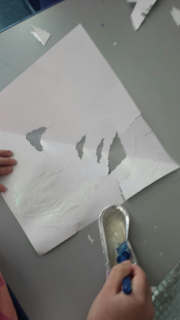
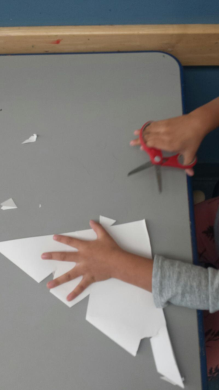
Using white paper folded into triangles and an assortment of different types of scissors, each child involved was encouraged to cut along the edges in whatever way they wished.

The children worked for quite a while, concentrating on the challenging task.  This artistic opportunity allowed them to express individual creativity, further improved fine motor skills and surely supported the development of hand-eye coordination.


Once their cutting was completed, they were invited to paint glitter glue on their creation.  This exercise was equally exciting to them as they saw their “snowflake” begin to sparkle.  


When the decorating was all done, each child seemed very proud of their finished product…"perfect paper snowflakes!”


Comments

Popular posts from this blog

4 Year Old M/W/F Class – I Hear…I See…I Wonder…

We began one of our circle discussions with a question for the children, “What would you like to learn, wonder or hear about?” Here is what they said:    “Skateboarding, Soccer, Perches” (Connor) “Bikes” (Taylor) “Going outside to see if I left my toy” (Jun)  “The Sun” (Jack) “Rollerskating and Swimming” (Daniella)"Skating” (Noel) “Ball” (Sofie) “Scooter and Tricycle” (Masaki) “Shoes” (Ashlan) “When you put something under a pillow you can find it” (Tia) “Soccer” (Kyle) From my list I noticed quite a few of the children were interested in wheels, so at our next circle discussion we looked closely at a scooter and a pair of roller skates – as well as the wheels on a long board. The conversation brought up more questions and answers, which the children confidently discussed amongst themselves. One of the questions was “What makes this a scooter?” The conversation followed with “The scooter has a handle and a brake” and “I know how to ride a long board.” ...

Social Responsibility: Down to the Core

Social responsibility- a term that has now become quite common in the field of education and has the potential to lose its meaning if we are not careful. As an early childhood educator, I have always placed great importance on the need to develop this way of thinking in young children. It is for this reason that we engage in activities that benefit others, such as volunteering at our local food bank, adopting an owl, or raising money for Variety Club. With the recent catastrophe in the Philippines, my mind was suddenly thrown into its own typhoon. I found myself asking questions around social responsibility and what it really means. What does it mean to me? What does it mean to my preschoolers? How far does it extend into the world around us? Can four year old children grasp these deep and complex concepts? What can they understand about their world? How can we teach them about being socially responsible to: ones self; ones family; ones community; ones province; ones country; ones worl...

And We Begin

This week marks a new beginning for all of us. And, with all new beginnings, it provides us with an opportunity to reflect on the past and think about what is to come. I have been going to yoga a lot this past while and one of the things the instructors mention at the onset of each class is to create an intention for your practice.  I thought a lot about this concept and decided that it would be interesting and important to apply it to my teaching on a deeper level than in the past. So, as I move into the year, I am hoping to set intentions, which I believe are different than goals. For me personally, goals are more structured and outcome driven. Intentions imply more of a journey. Balancing intentions with flexibility and openness will be the challenge.  I also want to explore the idea of children setting their own intentions. Can this work? Will they understand? Can we help support this idea without creating comparisons or pressure? I am really not sure. And so we begin...